
Test flights for Taiwan’s long-awaited F-16V fighter jets are set to commence this month, marking a key milestone in the island’s efforts to modernize its air force, according to Taiwanese Air Force Chief of Staff Lee Ching-jan.
Speaking before parliament on December 1, 2025, Lee announced that the trials would occur “earlier” than previously anticipated, with 54 of the 66 aircraft now entering the assembly line, up from 50 in October.
This reflects intensified production efforts by Lockheed Martin, the U.S. contractor, which has implemented two 20-hour shifts per weekday to address persistent supply chain disruptions and software integration challenges.
The $8 billion deal for these Block 70/72-configured jets was greenlit during former U.S. President Donald Trump’s first term in 2019, with initial deliveries targeted for 2026.
However, Defense Minister Wellington Koo cautioned last month that achieving full handover by year’s end remains “challenging” due to ongoing bottlenecks, including manpower shortages and component delays affecting not only Taiwan but also other buyers such as Bahrain, Slovakia, and Bulgaria.
Only about 10 aircraft are projected to complete assembly and testing by late 2025, with the first batch potentially arriving in early 2026 via trans-Pacific ferry flights supported by U.S. aerial refueling tankers.
The remaining jets are now slated for delivery through 2027 or early 2028, prompting Taiwan to extend the service life of its Mirage 2000 fleet in the interim.
These delays underscore broader strains in U.S. defense supply chains but do not diminish the strategic urgency for Taiwan, which is bolstering its defenses against Beijing’s territorial claims and repeated threats of force to achieve “reunification.”
The U.S., lacking formal diplomatic ties with Taiwan but committed under the 1979 Taiwan Relations Act to support its self-defense, has provided billions in arms sales—including fighters, missiles, and warships.
The new F-16Vs will join 141 upgraded legacy F-16A/B jets, completed under the $4.5 billion “Peace Phoenix Rising” program in late 2023, forming a unified fleet of more than 200 advanced Vipers by 2026.
Stationed primarily at Chiashan Air Base under the 7th Tactical Fighter Wing, they will enhance Taiwan’s ability to conduct air defense, maritime patrols, and joint operations amid escalating PLA incursions into its air defense identification zone (ADIZ).
The F-16V represents a 4.5-generation multirole powerhouse, far surpassing Taiwan’s aging F-16A/B fleet in avionics, radar, and endurance.
At its core is the Northrop Grumman AN/APG-83 SABR active electronically scanned array (AESA) radar, which delivers superior resilience against electronic countermeasures, enhanced detection of low-observable targets like cruise missiles, and extended beyond-visual-range (BVR) engagement envelopes.
Pilots benefit from an upgraded center pedestal display fusing SABR data with other sensors for improved situational awareness, alongside a helmet-mounted cueing system, Link 16 datalink, precision GPS, an Ethernet-based high-speed network, and a modular mission computer for seamless upgrades.
Structural enhancements include reinforced wings, fuselage, and landing gear, enabling higher takeoff/landing weights and a service life of 12,000 hours—50% longer than legacy F-16s—while reducing maintenance demands for sustained operations.
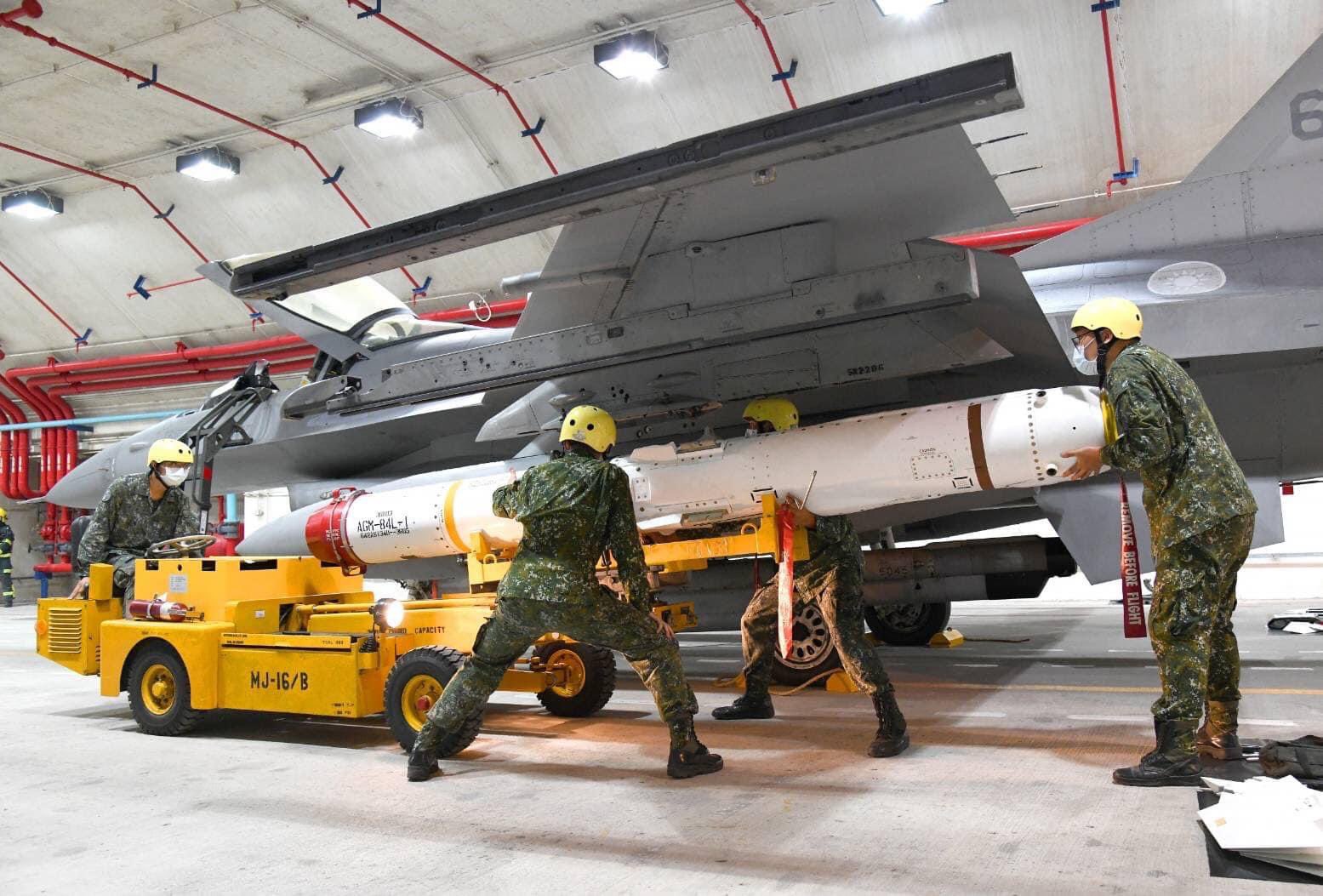
Armament versatility is a standout: the Viper supports heavy payloads like the AGM-84 Harpoon anti-ship missile, AGM-154 Joint Standoff Weapon (JSOW) for precision strikes, AGM-88 HARM for suppression of enemy air defenses, and—pending integration—the AGM-158 Joint Air-to-Surface Standoff Missile (JASSM), a low-observable, jam-resistant glide weapon with over 200-mile range.
Powered by the General Electric F110-GE-129 engine (29,000 pounds thrust), it offers superior maneuverability and combat radius, with nine hardpoints for up to 17,000 pounds of ordnance.
Yet even as Taiwan’s F-16V fleet takes shape, it confronts a formidable adversary in the People’s Liberation Army Air Force (PLAAF). The PLAAF’s fifth-generation edge is stark: over 300 Chengdu J-20 “Mighty Dragons” deployed across all five theater commands.
These stealthy air superiority fighters, now incorporating WS-15 engines for supercruise, outnumber the U.S. Air Force’s 187 F-22s and feature concealed PL-15 BVR missiles (200+ km range) for first-look, first-kill advantages.
Compounding the challenge, China unveiled its second fifth-generation platform, the Shenyang J-35A, at the Zhuhai Airshow in November 2024.
Looking further ahead, China’s sixth-generation ambitions are accelerating: prototypes of Chengdu J-36 (tailless diamond-wing design, ~65-foot wingspan) and twin-engine Shenyang J-50 have conducted multiple flights since December 2024, with the J-36’s second prototype—featuring thrust-vectoring nozzles and diverterless supersonic inlets—spotted at Lop Nur in October 2025.
Analysts project operational fielding by the mid-2030s, potentially outpacing U.S. Next Generation Air Dominance (NGAD) timelines.
The J-20’s low radar cross-section poses an acute threat to F-16Vs, enabling PLAAF pilots to engage Taiwanese jets via integrated KJ-500 airborne early warning platforms and beyond-line-of-sight missiles.
A J-20 pilot’s unverified 2024 claim of undetected overflights of Taiwanese airspace highlights this asymmetry, though Taiwan’s robust ground-based air defenses —including Patriot and indigenous Sky Bow systems—complicate PLA suppression efforts.
To counter stealth threats, the U.S. approved a $500 million sale of Legion Pod infrared search and track (IRST) systems in August 2023, now under a $345 million contract signed in June 2024; these heat-signature detectors bypass radar limitations, allowing F-16Vs to spot jets like J-20s at 100+ km via engine exhaust and airframe friction.
Taiwan’s Deputy Defense Minister Po Horng-huei asserted in March 2024 that the island maintains “absolute air superiority” in its airspace, citing layered defenses and firepower. However, experts view this as aspirational amid PLAAF’s rapid modernization.
The J-20 has never seen real combat, unlike the battle-proven F-16 Fighting Falcons. Still, Beijing’s quantitative edge is evident, fueled by a nearly $300 billion defense budget.