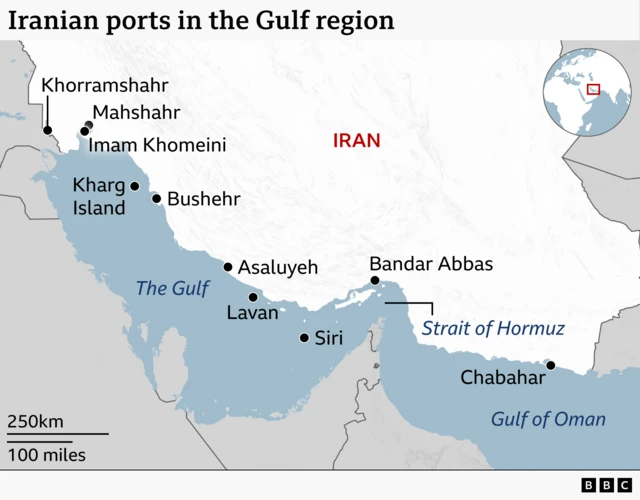
Blockading Iran’s ports means entering even more dangerous territory than the US was in before – legally, militarily and economically. It can be done, but at some risk.
The US Navy’s warships will not be loitering around just outside the harbour walls of say, Bandar Abbas or Jask. That would be to invite immediate attack by drone, missile or “kamikaze” speedboat.
Instead, Centcom, the part of the US military that covers the Middle East, will likely use satellite and other intelligence to ascertain which ships have left Iranian ports and who they belong to. Even with these vessels’ AIS (automatic identification system) transponders switched off, US warships sailing at a relatively safe distance offshore, will have no difficulty in finding them once they emerge into the Gulf of Oman, and interdicting them.
But Iran has called this threat an act of maritime piracy, a charge levelled at itself for constricting the Strait of Hormuz. The Islamic Republic has threatened in turn to act against neighbouring Gulf Arab ports.
Then there is the question of Iran’s allies: China and Russia. Will the US be prepared, say, to board and impound a Chinese-owned vessel or cargo? And what happens if China, which has a military base not far away in Djibouti, decides it will offer its ships an armed naval escort?