
Taiwan has moved to deter what it sees as an alarming rise in deliberate damage to its undersea cables, revising its laws to impose stiffer prison sentences of up to seven years.
The legal changes approved by Taiwan’s legislature on Tuesday come as the island accuses Beijing of sabotaging its submarine cables, describing such acts as “grey-zone” pressure tactics.
Mainland authorities have strongly denied any involvement, calling the incidents “common maritime accidents” and accusing Taipei of exaggerating the situation.
Under the newly amended laws covering telecommunications, electricity, gas, water, ports and navigation, intentional sabotage of undersea infrastructure now carries a prison sentence of one to seven years, plus a fine of up to NT$10 million (US$321,000).
Taiwan’s authorities also expanded their powers of confiscation: any vessel, tool or machinery used in such crimes, regardless of ownership, can be seized, auctioned, scrapped or repurposed for public use.
In addition, ships are required to keep their Automatic Identification System (AIS) turned on, and suspicious vessels can be detained or barred from port entry, according to the revised laws.Play
The amendments extend penalties to those who steal, damage or otherwise unlawfully compromise natural gas unloading and storage facilities as well as underwater potable water pipelines.
Those found to have inflicted negligent damage or unintentional harm may face up to six months in prison, detention or a fine of up to NT$2 million. This revision seeks to clearly define the distinction between negligence and deliberate sabotage.
A supplementary resolution passed alongside the amendments requires Taiwan’s interior ministry to publish maps and data of submarine cables and pipelines before the laws take effect.
This is meant to increase transparency and prevent inadvertent violations while also helping enforcement and investigations, according to the amendments.
Tuesday’s moves mark a major strengthening of Taiwan’s legal framework for undersea cables. Previously, such sabotage fell under narrower telecommunications laws, carrying lighter penalties and limited enforcement options.
Taiwan has seen multiple instances of submarine cable disruptions in recent years, which the authorities suspected were not accidents but deliberate acts.
According to its digital affairs ministry, Taiwan reported five cases of cable damage so far this year, compared with three in 2024. Between 2019 and 2023, there were 36 cases attributed to external damage.
In all, the island has 24 undersea cables, which include 14 dedicated to international communication and 10 connecting the main island to outlying archipelagos.
Taiwan’s authorities have said the frequency of these incidents underscores their concern that Beijing may be employing grey-zone tactics to destabilise the region without direct military conflict.
They point to a broader pattern that has included mainland Chinese naval and coastguard activity around the island, cyberattacks and deliberate damage to undersea infrastructure.
In January, Taiwan accused Shunxin 39, a mainland-owned vessel registered in Cameroon and Tanzania, of damaging a cable off its northern coast near Keelung. The ship’s owner denied the allegations.
In February, Taiwan detained the Togolese-flagged, mainland-operated cargo ship Hong Tai 58 after the undersea cable linking the main island and outlying Penghu was severed. The ship’s captain, surnamed Wang, was sentenced in August to three years in prison.
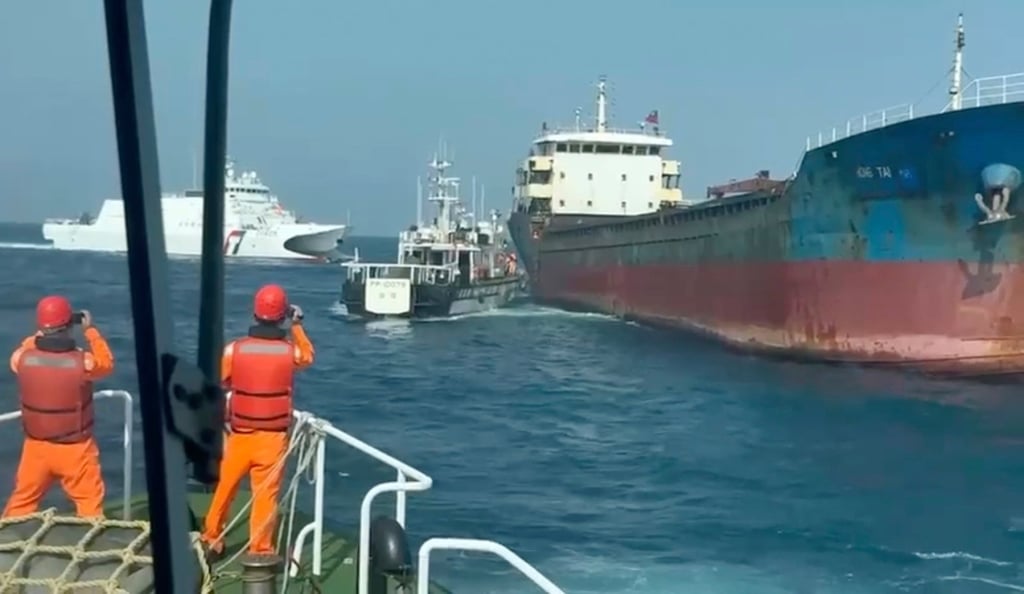
Beijing has dismissed the accusations, saying undersea cable damage occurs globally more than a hundred times a year and calling such claims a “deliberate exaggeration”.
Beijing sees Taiwan as part of China to be reunited by force if necessary. Since the independence-leaning Democratic Progressive Party came to power in 2016 and refused to accept the one-China principle, the mainland has ramped up military and diplomatic pressure on Taiwan.
Most countries, including the United States, do not recognise Taiwan as an independent state, but Washington is opposed to any attempt to take the self-ruled island by force and is committed to supplying it with weapons.
Submarine cables are the backbone of global digital communication. More than 99 per cent of trans-border internet traffic, financial data, international communication and even military transmissions depend on undersea fibre-optic cables.
This makes the cables among the most essential yet vulnerable infrastructures in the world today.
For Taiwan, the risk is especially high, given that it relies on a limited number of undersea cables to connect with global networks and outlying islands.
Analysts have said the combination of a limited infrastructure and heavy maritime traffic in the Taiwan Strait makes submarine cables a likely first target in any coercive or hybrid attack.
Domingo Yang I-kwei, assistant research fellow at the Institute for National Defence and Security Research, said in a report by the Taiwan-based think tank that submarine cables had become “priority targets for regional actors seeking to … sabotage or disrupt their rivals’ command-and-control systems”.
With 95 per cent of Taiwan’s internet and communications data traversing the largely unprotected cables, the government should significantly bolster safeguard measures, Yang added.