
Turkish industry and media alike have heralded the recent live-fire test in which a Kizilelma uncrewed combat air vehicle (UCAV) used a Turkish-made air-to-air missile to destroy a target drone. Turkey claims the test marks the first occasion a UCAV has launched a radar-guided air-to-air missile. But, while undoubtedly impressive, there are unanswered questions about how the engagement actually played out, especially to what degree the UCAV was being controlled by crewed fighter jets.
Outside of radar-guided missiles, it’s worth noting that the idea of drones firing air-to-air missiles is far from new. For example, in 2002, an urgent development program put infrared-guided AIM-92 Stinger air-to-air missiles on a U.S. Air Force MQ-1 Predator drone. A Stinger-armed Predator even fired at an Iraqi MiG-25 Foxbat, before the fighter downed the drone. The United States has also long explored the idea of employing MQ-9 Reapers in the air-to-air role, at least for self-defense. In a test in 2017, a Reaper successfully downed a target drone using an AIM-9X Sidewinder air-to-air missile. Earlier this year, it emerged that an MQ-9 was used to try and intercept an unidentified object in the air off the coast of Yemen in 2024. As you can read about here, this would appear to be the first known instance of a Reaper engaging an aerial target of any kind in an operational setting.
Returning to the Turkish test, this was conducted on November 28 and announced yesterday. A video released by Baykar, manufacturer of the Kizilelma, shows the UCAV — specifically aircraft PT-5 — taking off, together with four Turkish Air Force F-16s. In all, five F-16s were involved in the live-fire test, including one that served as a safety chase plane. An Akinci high-altitude long-endurance UCAV also flew chase duties.
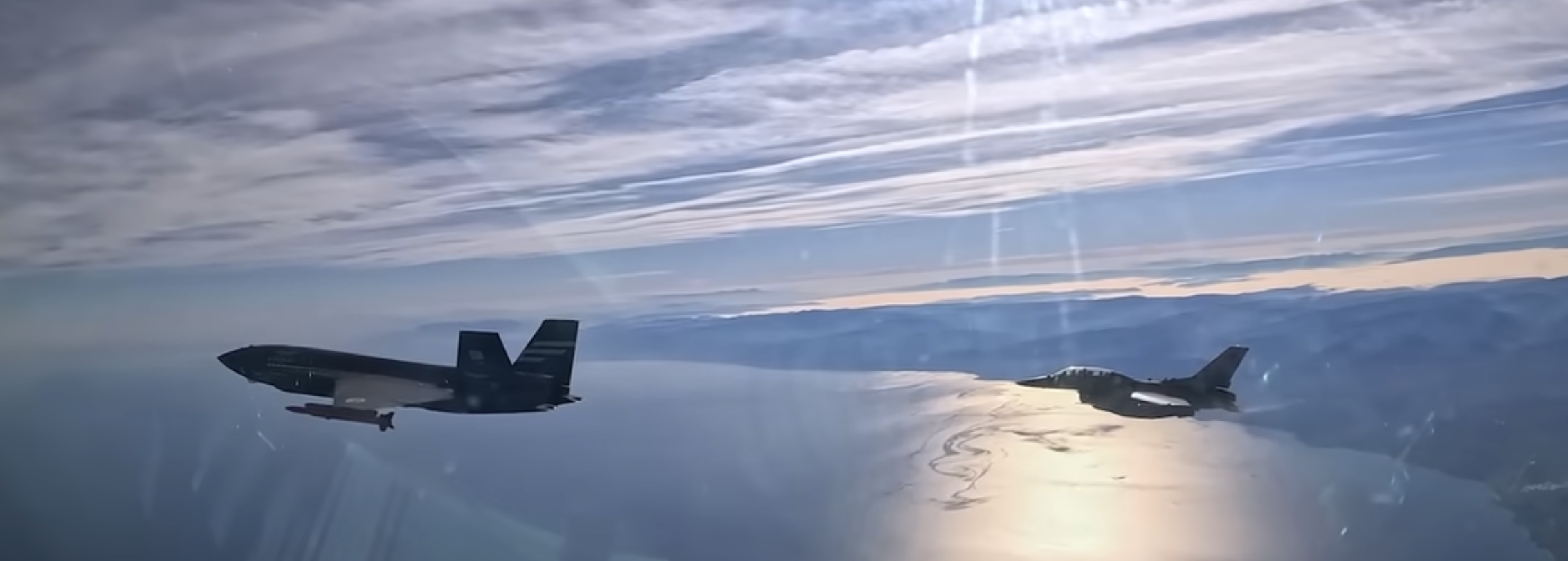
The Kizilelma was fitted with two Gökdoğan air-to-air missiles on external pylons. One of these was apparently inert, while the other, a powered missile (under the starboard wing), was fired at a target drone. It should be noted that external weapons carriage would degrade the radar signature reduction measures that the manufacturer says it has built into the UCAV. However, the drone is also planned to carry stores in an internal weapons bay, which would preserve such measures.